Physical Properties of CTIA’s MHC Alloy
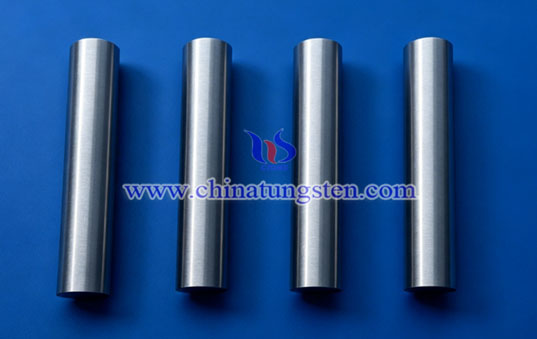
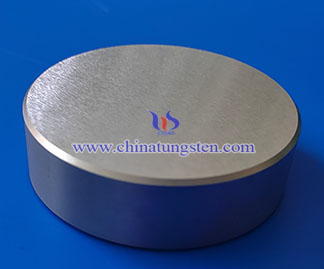
MHC alloy (Molybdenum Hafnium Carbon Alloy) is a typical dispersion-strengthened molybdenum-based high-temperature alloy. Its core performance originates from the synergistic effect between the molybdenum matrix and in-situ formed hafnium carbide (HfC) dispersion particles. The alloy exhibits excellent structural stability and mechanical reliability under coupled high-temperature and high-load conditions, making it suitable for long-term service in extreme thermal environments. The physical properties and characteristics of CTIA’s MHC alloy are mainly reflected in high-temperature strength retention, creep resistance, and microstructural stability.
CTIA’s MHC alloy combines excellent high-temperature strength retention, creep resistance, thermal fatigue resistance, and structural stability. It is a high-performance molybdenum alloy suitable for high-temperature, vacuum, and severe thermal cycling environments.
MHC alloy shows a room-temperature tensile strength of about 800 MPa and maintains about 500 MPa at 1000°C. The recrystallization temperature is above 1500°C, and the melting point is about 2620°C, allowing stable mechanical properties and microstructure during long-term high-temperature service.
The uniformly dispersed HfC strengthening phase effectively pins grain boundaries, suppresses dislocation motion, and inhibits grain boundary migration, significantly improving creep resistance and reducing deformation risk during long-term service at elevated temperatures.
MHC alloy also exhibits excellent thermal fatigue resistance, effectively relieving thermal stress concentration caused by rapid heating and cooling, and improving structural reliability under repeated thermal cycling.
Key thermophysical properties include:
(1) Thermal conductivity: 120–140 W/(m·K)
(2) Coefficient of thermal expansion: 4.8–5.5 ×10⁻⁶ /K
These properties provide high thermal conductivity, low thermal expansion, and excellent dimensional stability, improving thermal field uniformity and thermal shock resistance.
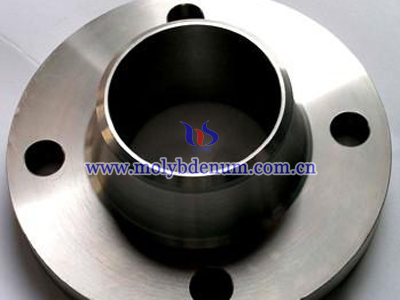
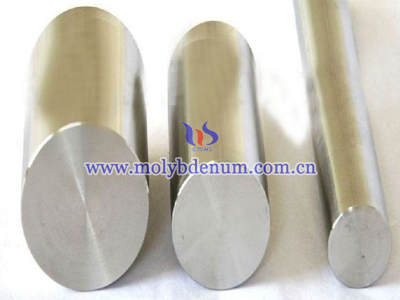
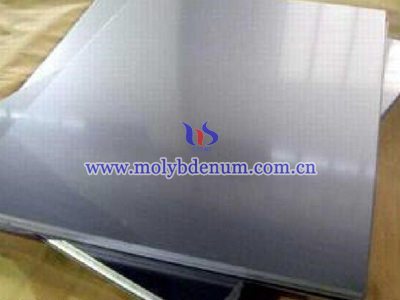
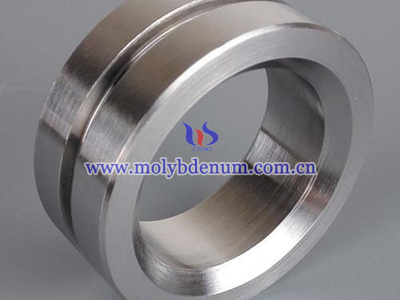
MHC alloy has a dense and uniform microstructure with good machinability, allowing turning, drilling, and grinding. It is suitable for manufacturing critical structural and functional components used in high-temperature and vacuum environments. The physical properties and characteristics of CTIA's MHC alloy are shown in the picture below:
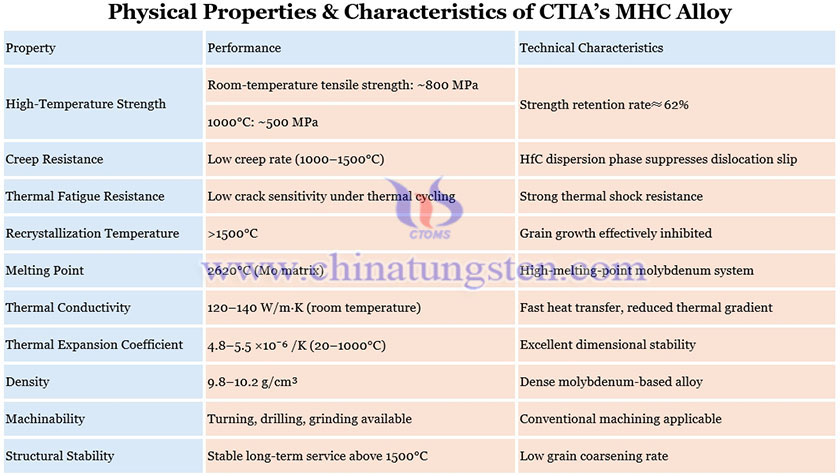
CTIA's MHC alloy significantly enhances the high-temperature strength, creep resistance, and microstructural stability of molybdenum-based materials through the HfC dispersion strengthening mechanism, enabling reliable service performance in ultra-high temperature, high-stress, and thermal cycling environments.
With nearly 30 years of deep expertise in molybdenum and molybdenum alloy manufacturing, CTIA GROUP has mature powder metallurgy and hot working control system. CTIA can stably provide high-performance-consistency MHC alloy products such as plates (sheets), rods (round bars), discs, tubes, rings, and customized parts, along with customized solutions to meet the stringent requirements of high-end industries for high-temperature structural materials.
For any inquiry, please contact molybdenum and molybdenum alloy manufacturer: CTIA GROUP
Email: sales@chinatungsten.com
Tel: 0086 592 5129696 / 0086 592 5129595
Website: www.molybdenum.com.cn
WeChat:

Related Products: