What's the Difference Between MHC Alloy and TZM Alloy?
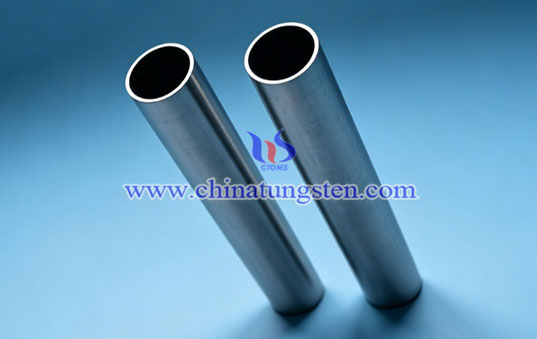
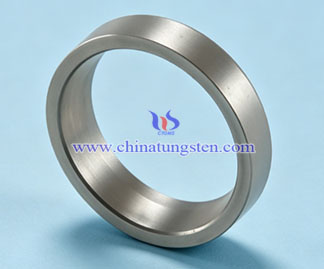
What is the difference between MHC alloy and TZM alloy? MHC alloy (Molybdenum Hafnium Carbon Alloy) and TZM alloy (Titanium Zirconium Molybdenum Alloy) are both molybdenum-based high-temperature alloys, but they differ fundamentally in strengthening mechanism, microstructure, and high-temperature performance. MHC alloy is strengthened by in-situ dispersed HfC (Hafnium Carbide) particles, while TZM alloy mainly relies on solid-solution strengthening and precipitation strengthening from TiC (Titanium Carbide) and ZrC (Zirconium Carbide). These differences result in distinct high-temperature stability and resistance to microstructural coarsening.
1.Strengthening Mechanism Comparison
MHC alloy forms nano- to submicron-sized HfC particles in situ during sintering through the reaction Hf + C → HfC. These uniformly dispersed particles effectively pin grain boundaries and inhibit dislocation motion.
TZM alloy is strengthened by solid-solution strengthening from titanium and zirconium in the molybdenum matrix, together with TiC and ZrC precipitates. These strengthening phases are relatively larger and exhibit slightly lower stability at elevated temperatures.
2.High-Temperature Performance Comparison
MHC alloy has recrystallization temperature above 1500°C and recommended maximum service temperature of approximately 1550°C.
TZM alloy has recrystallization temperature of about 1200–1400°C and is generally recommended for long-term service below 1400°C.
At 1000°C, MHC alloy maintains tensile strength of approximately 500 MPa, while TZM alloy experiences greater strength loss and relatively higher creep rate.
3.Microstructural Stability and Service Life Comparison
The fine and thermally stable HfC dispersion phase in MHC alloy effectively suppresses grain growth during long-term high-temperature service, providing superior creep resistance and thermal fatigue resistance.
TZM alloy performs well at medium and high temperatures. However, grain growth and precipitate coarsening become more pronounced at higher temperatures, resulting in relatively lower microstructural stability.
4.Application Comparison
TZM alloy is widely used for medium- to high-temperature structural components, dies, and general hot-working applications.
MHC alloy is better suited for ultra-high-temperature applications, including advanced hot-forming dies, vacuum furnace components, X-ray rotating anode targets, and aerospace hot-section structural components where maximum high-temperature performance is required.
5.Overall Comparison
The primary differences between MHC alloy and TZM alloy lie in their strengthening mechanisms, high-temperature performance, and service temperature range. MHC alloy utilizes an in-situ HfC dispersion-strengthening mechanism, providing recrystallization temperature above 1500°C, recommended service temperature up to 1550°C, and tensile strength of about 500 MPa at 1000°C. It offers superior creep resistance and microstructural stability, making it ideal for prolonged ultra-high-temperature service.
In comparison, TZM alloy relies on TiC and ZrC precipitation strengthening together with solid-solution strengthening. Its recrystallization temperature is about 1200–1400°C, and its recommended service temperature generally does not exceed 1400°C, making it suitable for medium- to high-temperature structural applications.
Both alloys provide high thermal conductivity and low thermal expansion. However, MHC alloy offers superior thermal shock resistance, long-term dimensional stability, and ultra-high-temperature capability. It is widely used in vacuum thermal systems, electron beam evaporation equipment, X-ray rotating anode targets, and aerospace high-temperature structures, while TZM alloy is more commonly applied in hot-working dies, extrusion tooling, and general high-temperature structural components. The overall comparison of CTIA’s MHC alloy and TZM alloy is shown in the picture as below:
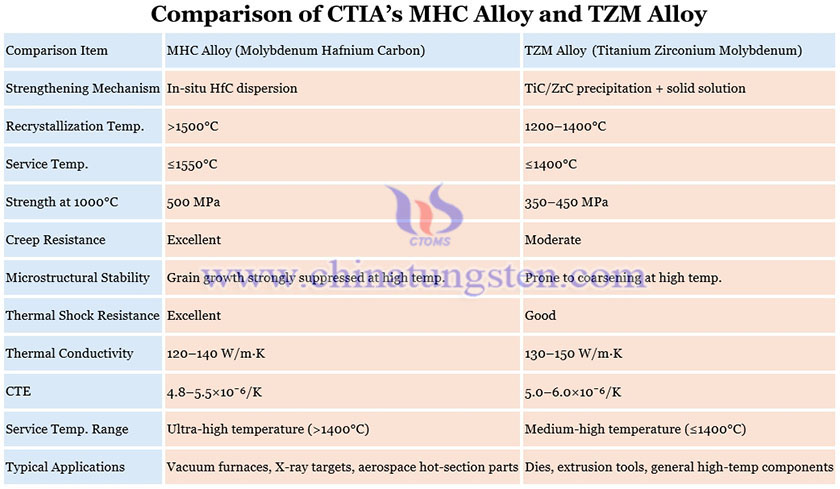
TZM alloy offers mature manufacturing technology and reliable overall performance. However, MHC alloy achieves better high-temperature performance through HfC dispersion strengthening, with superior high-temperature strength retention, creep resistance, and microstructural stability, making it more suitable for demanding service environments.
With nearly 30 years of experience in molybdenum and molybdenum alloy manufacturing, CTIA provides comparative selection guidance and customized solutions for both MHC alloy and TZM alloy, meeting engineering requirements across different temperature ranges and operating conditions.
For any inquiry, please contact molybdenum and molybdenum alloy manufacturer: CTIA GROUP
Email: sales@chinatungsten.com
Tel: 0086 592 5129696 / 0086 592 5129595
Website: www.molybdenum.com.cn
WeChat:

Related Products: